About Ananda School
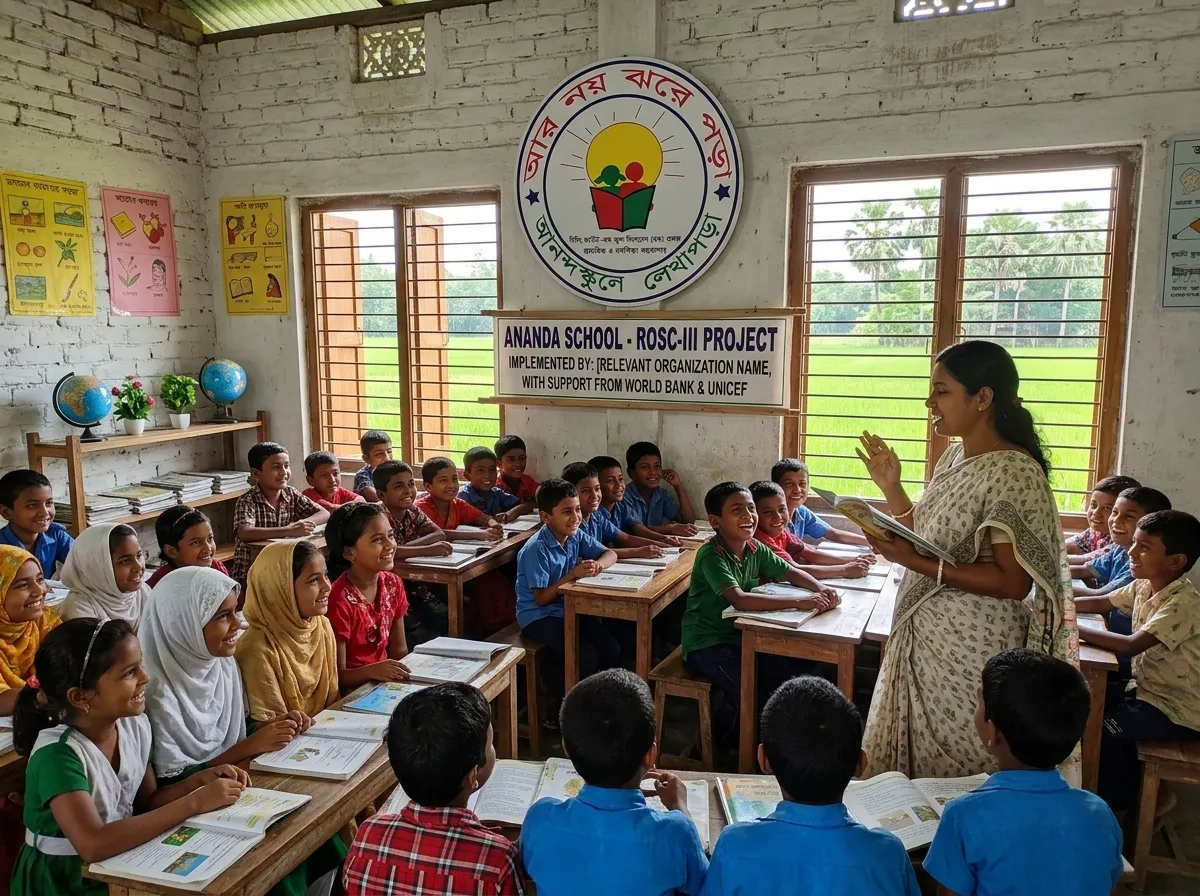
"Schools of Joy"
Giving Bangladesh's most vulnerable children a second chance at life and learning.
Ananda School: A Second Chance for Every Out-of-School Child
Ananda Schools (literally meaning "Schools of Joy") represent Bangladesh's most successful non-formal primary education model, established under the flagship ROSC-III Project.
Jointly supported by the Government of Bangladesh and the World Bank, Ananda Schools bring out-of-school children aged 8 to 14 back into the education mainstream. Through joyful learning without corporal punishment, flexible hours, and 100% free educational support, we transform the lives of disadvantaged children across rural villages, river islands, hill tracts, and urban slums.
Historical Timeline & Evolution
How Ananda School Started, Closed & Relaunched
From its inception in 2004 to its monumental relaunch in 2026, explore the complete journey of Ananda School and the ROSC Project in transforming education in Bangladesh.
ROSC-I: The Beginning
Ananda School was first launched in 2004 under the Reaching Out-of-School Children (ROSC-I) project by the Directorate of Primary Education (DPE) and the World Bank. Its mission was to combat high dropout rates in rural areas by creating flexible, community-managed learning centers for children who missed formal primary schooling.
ROSC-II & Successful Conclusion
The project expanded in 2013 as ROSC-II, establishing over 20,400 centers across 148 disadvantaged upazilas and urban slums, benefiting 690,000+ children. In 2022, ROSC-II officially concluded after successfully achieving its project objectives and integrating thousands of learning centers into formal primary schools.
Why Relaunched in 2026?
Why did it start again in 2026? Post-pandemic economic shock, climate displacement (river island char erosion and coastal flooding), and rapid urban slum growth forced millions of vulnerable children back out of school. To prevent a lost generation, the Government and World Bank relaunched the initiative as the flagship ROSC-III Project in 2026.
Collaborators & Governance
Who Cooperates & How It Is Operated
The success of Ananda School relies on a powerful multi-stakeholder partnership and community-driven operational framework:
Government & World Bank Cooperation
Implemented by the Directorate of Primary Education (DPE) under MoPME with substantial grant and credit assistance from the World Bank (IDA). Partner NGOs assist in teacher training and rigorous field monitoring.
How It Is Operated: 9-Member CMC
Each learning center is governed autonomously by a local 9-member Center Management Committee (CMC) made up of parents, village elders, and educators who manage funds, oversee teacher attendance, and ensure student safety.
Single-Teacher Cohort & Flexible Timing
One dedicated female teacher recruited from the village teaches the same student cohort from Grade 1 through Grade 5. Operating hours are flexible (morning/evening) so working children can attend without losing family income.
Why the Government Prioritizes Ananda School
The Government of Bangladesh places immense importance on the ROSC-III Project to fulfill international and national developmental pledges:
- SDG-4 (Education for All): Ensuring universal foundational literacy and numeracy for every child by 2030 without discrimination.
- Eradicating Child Labor: Providing financial incentives and free schooling to rescue working youth and domestic helpers from hazardous labor.
- Smart Bangladesh Vision 2041: Building an equitable digital and educated society where no rural or slum community is left behind.
- Gender Empowerment: Mandating at least 50% female student enrollment and prioritizing women in teacher recruitment.
Target Beneficiaries
Which Disadvantaged Children Study Here?
Ananda Schools are tailored specifically for the most marginalized primary-school-aged children (8 to 14 years) who cannot attend traditional brick-and-mortar schools.
School Dropouts
Children who had to abandon formal schooling due to sudden family poverty, parental illness, or inability to pay private tuition fees.
Char & Haor Children
Children living in remote river islands (chars), wetland haors, and hilly tribal belts where formal schools are physically inaccessible.
Working Youth & Slum Kids
Urban slum street children, child laborers in informal workshops, and domestic helpers who require evening or afternoon learning shifts.
Disadvantaged Girls
Special emphasis on protecting and educating girl children who face early marriage risks, ensuring over 50% female classroom enrollment.
A to Z Educational Benefits
What Ananda School Provides (A to Z Support)
To ensure zero financial burden on impoverished parents, the ROSC-III Project provides a comprehensive package of free educational resources and direct monetary stipends.
100% Zero Tuition Fee
Completely free primary education from Grade 1 to Grade 5 with zero admission fees, monthly tuition charges, or exam fees.
Free Government Books
Every student receives full sets of brand new official national curriculum textbooks published by the National Curriculum and Textbook Board (NCTB).
Free Uniforms & School Bags
Students are provided with free school uniforms, durable backpacks, and student ID cards to instill dignity, pride, and equality.
Free Learning Stationery
Regular distribution of free exercise notebooks, writing pens, pencils, erasers, sharpeners, and geometry boxes throughout the academic year.
Mobile Banking Stipends
Bi-monthly educational allowances and attendance stipends transferred directly into mothers' mobile banking accounts (bKash/Nagad) to reduce family poverty.
Mainstreaming Certification
Official primary education completion certificates upon passing Grade 5, enabling students to seamlessly enroll in formal high schools or vocational institutes.
Ready to Make a Difference in a Child's Life?
Join hands with DPE, World Bank, and local communities to bring out-of-school children back to the classroom.